Introduction
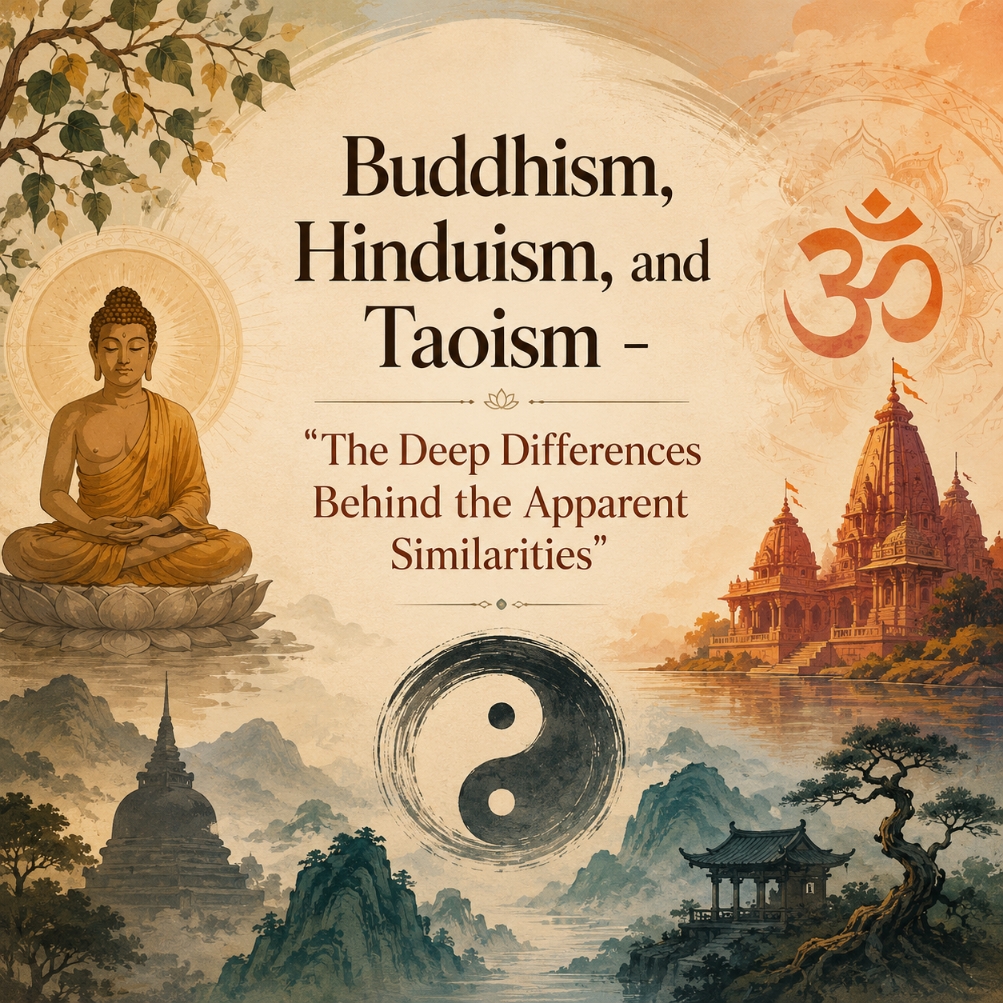
When a person first comes into contact with Eastern philosophy, they often get the impression that Buddhism, Hinduism, and Taoism are almost the same thing. All three traditions speak of inner peace, harmony, liberation from suffering, and life beyond the ego. All three use practices of contemplation, meditation, and discipline of consciousness. In popular culture, they are often blended into one general category called “Eastern wisdom,” without distinguishing between their historical roots, philosophical foundations, and ultimate goals.
The truth, however, is far more interesting. Although these systems share points of contact, they differ fundamentally in the way they understand the human being, nature, reality, suffering, the meaning of life, and the path toward spiritual development. Buddhism emerged in the cultural environment of ancient India and is deeply connected with the philosophical searches of the Hindu world. Taoism, on the other hand, was born in China and carries a completely different spirit – softer, more intuitive, more natural, and less oriented toward strict spiritual liberation.
Today, millions of people around the world practice meditation, yoga, Zen, tai chi, or various spiritual techniques without realizing where these ideas actually come from. Yoga is often presented simply as a system of exercises, Buddhism as a philosophy without a god, and Taoism as a poetic way of thinking about nature. But when one goes deeper, it becomes clear that behind these concepts stand vast civilizational layers.
Hinduism is one of the oldest living spiritual systems in the world and represents a boundless universe of gods, rituals, philosophies, and practices. Within it developed different schools of yoga, concepts of karma and rebirth, as well as the idea of liberation from the cycle of birth and death. Buddhism emerged as a reaction against certain aspects of this environment, but it preserved much of its philosophical language. This is why many scholars regard Buddhism as a kind of branch or reformation of the broader Indian spiritual tradition.
Taoism, however, follows a completely different path. Instead of striving for liberation from the world, it rather seeks harmony with the very flow of life itself. Instead of speaking about karma and rebirth, it speaks about the Tao – the ineffable principle that moves nature. Instead of strict discipline and renunciation of desires, Taoism often offers naturalness, spontaneity, and softness.
Nevertheless, there is a visible closeness between Taoism and Zen Buddhism. This closeness is not accidental. When Buddhism entered China, it inevitably began to blend with local Chinese culture, and especially with Taoist sensibility. It is precisely from this interaction that Zen later emerged.
To understand the real differences between these three traditions, it is necessary to examine their historical roots, their views of the human being and the world, their methods of spiritual practice, and their ultimate goals. Only in this way can one see why Buddhism is both close to and different from Hinduism, and why Taoism resembles Zen but remains something entirely separate.
The Historical Roots of Hinduism
Hinduism is not a religion in the usual sense of the word. It has no single founder, no single dogma, and no centralized institution. Rather, it represents an enormous civilizational tradition that developed over thousands of years on the territory of India.
Its most ancient roots can be found in Vedic culture. The Vedas are sacred texts created more than three millennia ago. They contain hymns, ritual formulas, and philosophical ideas connected with the structure of the cosmos and the place of the human being within it.
Initially, Vedic religion was strongly ritualistic. Sacrifices and the correct performance of sacred actions were considered the basis of harmony between people, nature, and the gods. Gradually, however, a deeper philosophical search began to appear in Indian thought.
This search reaches its culmination in the Upanishads. It is there that some of the most important ideas of Hinduism arise – Brahman, Atman, karma, samsara, and moksha.
Brahman is the absolute reality, the infinite principle behind all that exists. Atman is the true essence of the human being. One of the deepest ideas in Hindu philosophy is that Atman and Brahman are ultimately one and the same.
Karma means that every action has consequences. Samsara is the cycle of birth and rebirth. Moksha is liberation from this cycle.
These concepts become fundamental for almost all later Indian spiritual schools. It is precisely upon them that Buddhism would later build, although in a greatly transformed form.
Yoga as Part of the Hindu Tradition
Today many people associate yoga mainly with physical exercises. This is a modern interpretation that has little in common with the original meaning of the word.
In the classical Indian context, yoga is a system of spiritual discipline and transformation of consciousness. It represents a method for attaining liberation.
There are different forms of yoga. Karma yoga is the path of action. Bhakti yoga is the path of devotion. Jnana yoga is the path of knowledge. Raja yoga is the path of meditation and control of the mind.
It is precisely within these spiritual practices that the environment from which Buddhism later emerged was formed. Historically, the Buddha did not appear in a vacuum. He lived in a world where meditative techniques, ascetic practices, and philosophical schools concerned with liberation from suffering already existed.
Even the very idea that a person can attain enlightenment through inner discipline is part of the broader Indian spiritual atmosphere.
That is why it is often said that Buddhism is a kind of branch of the deeper yogic tradition of India. Of course, Buddhism later developed its own identity and began to differ greatly from classical Hinduism, but the historical connection between them remains obvious.
The Appearance of the Buddha and the Birth of Buddhism
Siddhartha Gautama, later known as the Buddha, lived approximately in the 5th century BCE. He was born in northern India in an environment saturated with spiritual searching.
At that time, many philosophical schools, ascetic movements, and yogic practices already existed in India. The ideas of karma, rebirth, and liberation were widespread.
The Buddha began his search precisely within this cultural environment. He studied meditative techniques with various teachers, practiced extreme asceticism, and sought a way to overcome suffering.
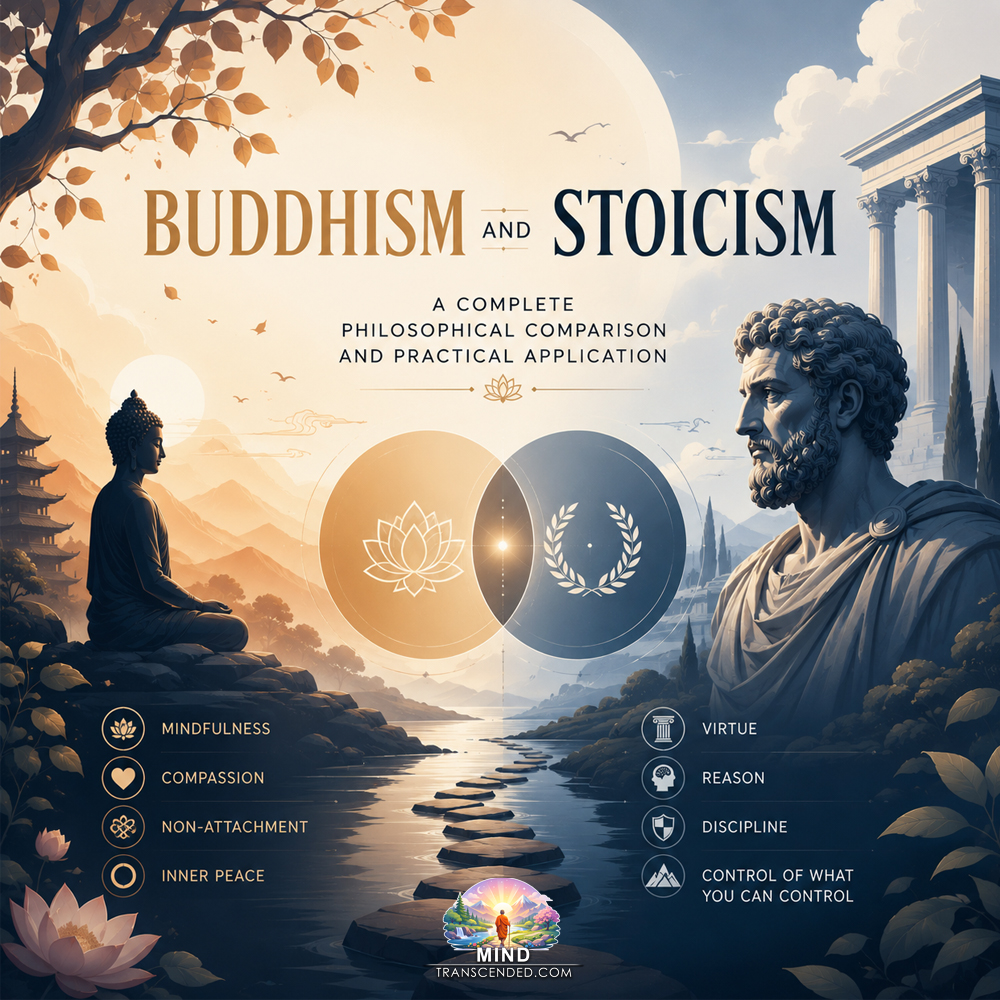
After a long period of spiritual practice, he attained enlightenment under the Bodhi tree. It was then that he formulated the basic principles of Buddhism.
The Four Noble Truths stand at the center of his teaching. The first truth states that life is filled with suffering. The second claims that the cause of suffering is attachment and desire. The third teaches that suffering can be ended. The fourth describes the path toward that cessation.
This path is the Eightfold Path – a system of ethical, mental, and meditative practices.
Although Buddhism emerged from the Indian spiritual environment, it takes one very important step in a different direction. The Buddha rejects the idea of an eternal Atman.
Here lies one of the most essential differences between Hinduism and Buddhism.
Atman versus Anatman
In classical Hinduism there is a belief that behind the changing personality stands an eternal spiritual essence. This essence is Atman. Buddhism, however, denies the existence of a permanent and unchanging Self.
According to the Buddhist point of view, the human being is a collection of constantly changing processes. There is no fixed soul that remains identical over time.
This concept is called anatman.
Here the difference between Hinduism and Buddhism becomes fundamental. While Hinduism often seeks the discovery of the true Self, Buddhism strives for the realization that such a permanent Self does not exist at all.
This changes the entire approach to spiritual practice. In Hinduism, liberation often means the union of Atman with Brahman or the realization of their unity.
In Buddhism, enlightenment means the ending of ignorance and liberation from attachment to the idea of a separate “self.” This difference is enormous, although outwardly the two traditions may sometimes seem similar.
Karma and Rebirth in Hinduism and Buddhism
Both Hinduism and Buddhism accept the idea of karma and rebirth. But the way they understand them is not completely the same.
In Hinduism, karma is connected with the spiritual evolution of the soul through different lives. The soul accumulates consequences from its actions and passes through the cycle of samsara until it reaches liberation.
In Buddhism there is no eternal soul, yet there is still a continuation of cause-and-effect processes. This is often explained through the analogy of a flame that lights another flame. There is continuity, but no unchanging essence.
This idea is difficult to understand from a Western point of view, because Buddhism simultaneously speaks of rebirth and denies a permanent Self. It is exactly here that one can see how strongly Buddhism inherited the Indian spiritual framework, but also how radically it transformed it.
Meditation in Hinduism and Buddhism
Meditation plays a central role in both traditions. In Hinduism, meditative practices are often connected with contemplation of the divine, control of the mind, and attainment of unity with absolute reality.
In Buddhism, meditation is directed toward awareness of the nature of the mind and the cessation of suffering. Despite the differences, there is a deep historical connection between Hindu yoga and Buddhist meditation.
Many of the techniques used in Buddhism developed precisely within the older Indian meditative traditions. This does not mean that Buddhism is simply a copy of Hinduism. But it does mean that it cannot be understood outside the Indian spiritual environment.
The Development of Mahayana and Zen
Over time, Buddhism divided into different schools. Theravada preserves the earlier forms of Buddhist teaching and is spread mainly in Sri Lanka and Southeast Asia. Mahayana developed a broader and philosophically rich tradition. It is precisely within Mahayana that Zen later emerged.
When Buddhism reached China, it encountered a completely different culture. Chinese thought was strongly influenced by Confucianism and Taoism. Buddhist ideas gradually began to be refracted through Chinese sensibility.
It is exactly here that Chan Buddhism arose, which later became known in Japan as Zen. Zen is distinguished by directness, minimalism, and a strong emphasis on immediate experience.
It is here that the influence of Taoism becomes especially visible.
How Taoism Emerged
Taoism appeared in ancient China at approximately the same time that the Buddha lived in India.
The main figure associated with its beginning is Lao Tzu. The Tao Te Ching – one of the most mysterious and influential texts in human history – is traditionally attributed to him.
Unlike Hinduism and Buddhism, Taoism does not place such a strong emphasis on liberation from the cycle of rebirth. Its focus is on harmony with the Tao.
The Tao cannot easily be defined. It is the way, the principle, the natural flow of reality.
At the very beginning of the Tao Te Ching, Lao Tzu says that the Tao that can be spoken is not the true Tao. This shows the fundamental difference between the Taoist approach and the more systematic Indian philosophies.
Taoism does not strive so much for a logical explanation of the universe. It prefers intuition, paradox, and the immediate feeling of life.
The Principle of Wu-Wei
One of the most famous ideas in Taoism is wu-wei. This concept is often translated as “non-action,” but this is an inaccurate translation. Rather, it refers to action without violence against the natural flow of life.
Taoism teaches that a person suffers when they try too hard to control the world. The wise person does not wage war against reality. They move together with it.
This idea is very different from the ascetic and disciplined approaches often found in Indian spiritual traditions.
While a Buddhist monk may follow a strict practice of meditation and self-discipline, the Taoist sage is often presented as natural, free, and spontaneous.
Nature in Taoism
Taoism has a special attitude toward nature. For the Taoist, nature is a perfect teacher. The river does not struggle, yet it reaches the ocean. The tree grows effortlessly. The wind does not plan its direction. Taoism sees in these natural processes a model for human life.
Here there is an important difference with Buddhism.
Buddhism often views the world as a place of suffering and impermanence from which a person must be liberated.
Taoism is more reconciled with the world. It does not seek escape from the natural order, but harmonious participation in it.
Taoism and Zen
When Buddhism entered China, it inevitably began to blend with Taoist culture. This interaction created a special form of Buddhism that later became Zen.
Many of the characteristic features of Zen carry strong Taoist influence. Short paradoxical statements, immediacy, respect for simplicity, love of nature, and an intuitive approach to reality are close to the Taoist spirit.
But despite this closeness between Zen and Taoism, important differences exist. Zen remains a form of Buddhism. It preserves basic Buddhist ideas such as suffering, impermanence, the absence of a permanent Self, and the striving for enlightenment.
Taoism does not have the same structure of spiritual liberation. It does not concentrate so much on ending suffering as on natural balance. This is one of the most essential differences.
The Buddhist Attitude Toward Desires
Buddhism regards desires as a primary source of suffering. This does not refer simply to material desires. Even attachment to ideas, identity, and expectations can be a form of suffering.
The goal of Buddhist practice is gradual liberation from this attachment. Here Buddhism may seem quite strict. Monastic life, meditative discipline, and ethical rules are an important part of the tradition.
Taoism, however, approaches this differently. It rarely speaks of the radical denial of desires. Rather, it encourages naturalness and moderation. Instead of fighting with yourself, you must stop complicating life.
This difference creates a different atmosphere in the two traditions.
Buddhism often has a sense of discipline and inner transformation. Taoism carries a sense of lightness and flow.
The Hindu Gods and the Buddhist Perspective
Hinduism is filled with gods and mythological images.
Shiva, Vishnu, Kali, Krishna, and many other deities play a central role in various Hindu traditions. These gods are not always understood literally. In many cases, they symbolize different aspects of cosmic reality.
Shiva, Vishnu, Kali, Krishna, and many other deities play a central role in various Hindu traditions. These gods are not always understood literally. In many cases, they symbolize different aspects of cosmic reality.
Buddhism was initially less theistic. The Buddha did not place emphasis on worshiping a god. Nevertheless, in later Buddhism numerous deities, bodhisattvas, and mythological figures also appear. This is especially visible in Tibetan Buddhism. But even then, the central focus remains on enlightenment, not on worship.
Taoism, for its part, developed its own pantheon and religious system, especially in its later forms. Popular religious Taoism includes gods, spirits, alchemy, and various rituals.
But the philosophical Taoism of Lao Tzu and Zhuangzi remains closer to intuitive wisdom than to organized religion.
The Attitude Toward the Ego
All three traditions examine the problem of the ego in different ways. In Hinduism, the ego is often understood as a limited identity that prevents a person from realizing their true spiritual nature. In Buddhism, the ego is an illusion, the result of ignorance. In Taoism, an excessive ego is a form of unnaturalness.
Interestingly, all three traditions criticize excessive fixation on the personality, but they do so for different reasons.
Hinduism wants a person to discover their eternal essence. Buddhism wants a person to realize that there is no permanent essence. Taoism wants a person to stop being artificial and forceful.
Suffering as a Central Theme
Buddhism places suffering at the center of its philosophy. Life is impermanent. Everything changes. Attachment leads to pain. The entire Buddhist practice is directed toward liberation from this condition.
Hinduism also recognizes the suffering of human existence, but often views it within a broader cosmic order.
Taoism has a different tone. It does not analyze suffering in such detail. Rather, it suggests that many human problems arise because people live in contradiction to the natural flow. Thus Taoism offers not so much liberation from the world as a proper way of existing within it.
The Role of the Body
In Hinduism, the body can be an instrument for spiritual development. Yoga uses physical postures, breathing, and energy practices as part of a deeper spiritual discipline.
Buddhism sometimes looks more suspiciously at bodily attachments, although the attitude varies across different schools.
Taoism often has a more positive attitude toward vital energy and natural embodiment. Taoist practices such as qigong and tai chi are aimed at harmonizing energy, not at escaping from the body.
This is also an essential difference.
Individualism and Community
Hinduism has traditionally been strongly connected with the social structure of India. The caste system has historically played an important role in Hindu society.
Buddhism opposes this to some extent. The Buddha taught that every person can attain enlightenment regardless of their social status. This makes Buddhism more universal.
Taoism, meanwhile, often stands apart from political and social structures. Many Taoist sages are portrayed as hermits who leave society and seek a simple life close to nature.
Time and Cyclicality
Hinduism sees time as a vast cosmic cycle. The world passes through different ages that repeat themselves. Buddhism also accepts the cyclicality of existence.
Taoism is less focused on the cosmic cycles of rebirth and more on the immediate rhythm of nature. The change of seasons, the movement of water, the balance between yin and yang – these are its main symbols.
Yin and Yang versus Indian Dualism
Taoism develops the concept of yin and yang. These are not opposites in the sense of an absolute struggle. They are mutually complementary forces. Light contains darkness. Darkness contains light. Everything is in movement and balance.
Indian traditions often work with various forms of dualism between matter and spirit, ignorance and enlightenment, samsara and liberation.
Taoism usually avoids such sharp oppositions. This gives it a softer and more organic character.
Enlightenment in the Three Traditions
In Hinduism, enlightenment often means realizing the unity between the individual soul and absolute reality.
In Buddhism, enlightenment means the ending of ignorance and liberation from attachment.
In Taoism, there is no exact equivalent of Buddhist nirvana. The Taoist sage does not “leave” the world. He becomes completely natural. This difference is very important.
Buddhism has a strongly expressed soteriological goal – salvation or liberation. Taoism is rather a philosophy of harmony.
Why the Western World Mixes These Traditions
In the modern world, Eastern traditions are often presented in a highly simplified form.
Yoga becomes a fitness practice. Buddhism is reduced to a technique for calmness. Taoism is romanticized as poetic wisdom. This creates the impression that all these systems are almost identical.
But when a person begins to read the original texts and understand the historical context, the differences become enormous. Buddhism cannot be fully understood without the Hindu and yogic environment from which it originates. Taoism cannot simply be reduced to “Chinese Zen.”
And Hinduism is such a vast civilizational system that even by itself it contains many different philosophies.
Buddhism as a Reformation of Indian Spirituality
Many scholars compare the relationship between Hinduism and Buddhism to the relationship between Christianity and Judaism. Buddhism arises within Indian culture, uses the existing concepts of karma, meditation, and liberation, but rethinks them. It removes the authority of the Vedas, rejects caste restrictions, and questions the idea of an eternal soul. Nevertheless, it remains deeply connected with the Indian spiritual atmosphere.
That is precisely why some people view Buddhism as a kind of branch of the broader yogic and Hindu tradition. This connection should not be ignored.
Many of the core Buddhist practices developed precisely in the context of ancient Indian meditative techniques.
Taoist Softness versus Buddhist Discipline
One of the most noticeable differences between Taoism and Buddhism is the psychological atmosphere. Buddhism often has a sense of serious inner work. Observation of the mind, discipline, meditation, renunciation of attachments.
Taoism appears softer. It teaches that excessive effort may only increase confusion. Instead of constantly fixing yourself, perhaps you simply need to stop disrupting your natural rhythm.
This is a very different approach to spirituality.
Silence and Paradox
Both Buddhism and Taoism use paradoxes. But in Zen, paradox often serves to break down the rational mind and reach sudden insight.
In Taoism, paradox rather expresses the impossibility of enclosing life within rigid concepts.
Both traditions value silence.
But Buddhist silence is often part of a practice of awareness. Taoist silence is closer to natural calm.
The Attitude Toward the World
Buddhism often emphasizes the impermanence and suffering of the world. Taoism sees the world as a natural process. Hinduism may view the world as a divine play or as an illusion, depending on the particular school.
These different perspectives lead to different spiritual moods. Buddhism is analytical. Taoism is intuitive. Hinduism is cosmic and metaphysical.
Practical Differences
If a person enters a Buddhist monastery, they will likely encounter a strict routine, meditation, discipline, and careful observation of the mind. If they visit a traditional Hindu temple, they will see rich rituals, mantras, images of deities, and various forms of worship. If they enter a Taoist environment, they may sense a stronger emphasis on nature, energy, breathing, and harmony.
These differences show that despite all the shared themes, the three traditions remain profoundly different.
These differences show that despite all the shared themes, the three traditions remain profoundly different.
Modern Interest in Zen and Taoism
In the West, Zen and Taoism often attract people who feel tired of the excessive rationality of modern life. Their minimalism, simplicity, and calm appear liberating. But sometimes this popularity leads to romanticization.
Taoism is not merely an aesthetic of peaceful gardens. Zen is not merely a relaxation technique. Both traditions have deep philosophical and spiritual foundations.
The Difference Between Harmony and Liberation
Perhaps the shortest way to summarize the difference between Taoism and Buddhism is the following. Buddhism seeks liberation. Taoism seeks harmony.
Buddhism sees the human mind as caught in the trap of ignorance and attachment. Taoism sees the human being as a creature that has become disconnected from the natural flow. Buddhism often proceeds through discipline. Taoism prefers softness.
And yet there is a deep kinship between them, especially in Zen.
Why These Differences Matter
Understanding the differences between Hinduism, Buddhism, and Taoism is not merely an academic question. It helps a person understand the different possibilities for relating to life.
Hinduism offers a cosmic vision of reality. Buddhism offers a psychological and existential analysis of suffering. Taoism offers a philosophy of naturalness. These three approaches continue to influence millions of people to this day.
Conclusion
Buddhism, Hinduism, and Taoism often appear similar because of their shared interest in inner development, meditation, and overcoming the ego. But behind this apparent closeness stand different civilizational worlds.
Hinduism is an ancient and vast spiritual system within which yoga, the ideas of karma and rebirth, and the striving for liberation developed.
Buddhism emerged precisely in this environment and inherited much of its language and practices, but transformed them radically. It rejects the idea of an eternal Self and places liberation from suffering through awareness at the center.
Taoism, for its part, follows a completely different sensibility. It does not seek escape from the world, but harmony with it. It does not insist so much on discipline and renunciation as on naturalness, softness, and flow.
Although Zen Buddhism carries strong Taoist influence, it remains a Buddhist tradition with its own goal – enlightenment.
It is precisely these nuances that make Eastern philosophy so deep and interesting. The more a person enters into it, the more clearly they see that behind common words such as “meditation,” “enlightenment,” and “harmony” lie completely different understandings of the human being and reality.
And perhaps it is precisely in this diversity that the true richness of these traditions lies.
Read More:
- If You Meet the Buddha, Kill Him: The Radical Zen of Linji
- Hakuin Ekaku – The Great Master Who Revived Zen in Japan
- Yoga: Karma, Life, Death, and Rebirth
- Huineng – The Extraordinary Story of the Sixth Zen Patriarch
- Zhuangzi – The Sage of the Free Spirit and the Infinite Tao
- Bodhidharma – The Fierce Zen Master Who Brought Buddhism to China
- Lao Tzu: The Sage of Tao and the Secret of Eternal Simplicity
- Zen: The Path Beyond Words – History, Development, and the Living Presence of Awakening
Author: Vasil Stoyanov