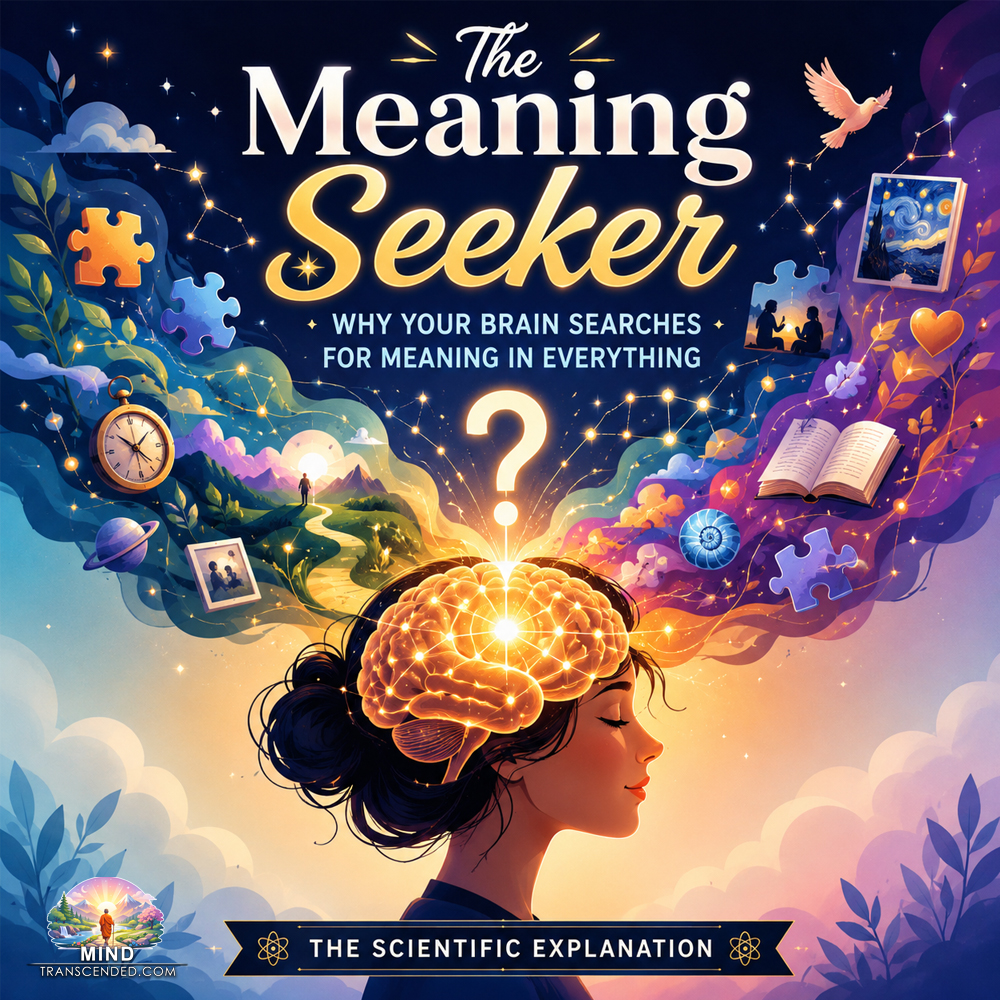
There is something deeply human in standing before chaos and refusing to accept it as the final answer. To look at randomness – in the noise of the city, in the coincidences of everyday life, in the order of numbers – and to feel, almost instinctively, that behind all of it there must be meaning. That things cannot simply be as they are – without reason, without intention, without a message.
This need is not a weakness. It is built into the very architecture of the human brain.
But here an uncomfortable question arises:
What if our brain is so good at discovering meaning that it begins to create it where it does not exist?
The Evolution of Meaning: Why Error Was Useful
To understand why the brain searches for patterns everywhere, we must go back – not into the history of ideas, but into the history of survival.
The human brain did not evolve to discover objective truth. It evolved to increase the probability of survival. This means that it prefers to make certain types of errors – errors that are less dangerous.
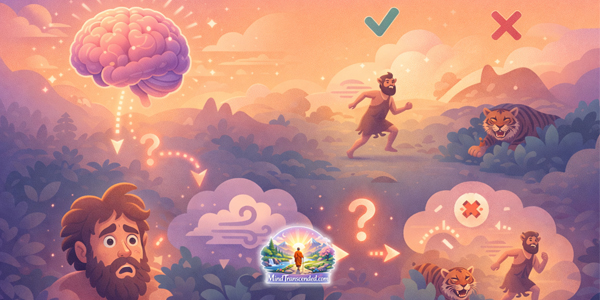
If you hear a noise in the bushes, there are two possibilities:
– To assume it is the wind – or to suppose it is a predator.
If you are wrong and there is no predator – you lose a little energy.
If you are wrong and there is a predator – you lose your life.
Evolution has systematically selected brains that “overestimate” the presence of patterns, intentions, and agents. This tendency is known in cognitive science as hyperactive agency detection – the tendency to attribute intention and meaning to neutral phenomena.
This is the first layer of meaning: not philosophical, but biological.
Apophenia and Pareidolia
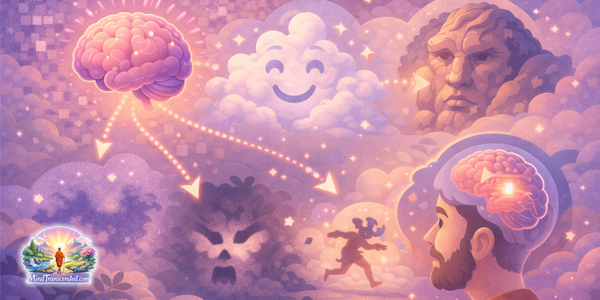
With the development of science, it becomes clear that this tendency is not limited to situations of danger. It penetrates every level of perception. The term apophenia describes precisely this – the tendency to discover patterns and connections in random data. A more specific form is pareidolia, in which we see familiar shapes (most often faces) in chaotic structures – clouds, rocks, shadows.
Neuroscientific studies show that when a person “recognizes” a face in noise or an abstract image, the same brain regions involved in real face recognition are activated – such as the fusiform face area. For the brain, this experience is not a metaphor. It is reality.
In one experiment, participants were shown completely random visual noise and were told that some of the images contained hidden figures. Many began to “see” structures even when none were present. Even more interestingly, their confidence did not decrease – on the contrary, it often increased. This leads us to an important conclusion:
– The brain does not merely interpret the world – it constructs it.
Skinner’s Experiment
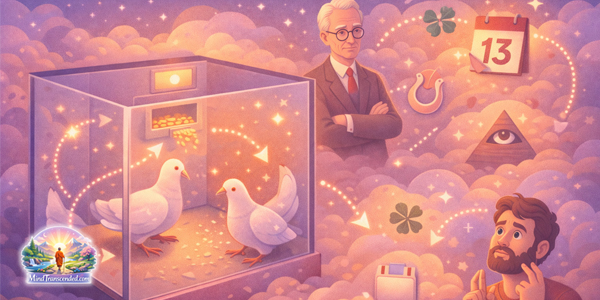
The search for meaning is not limited to perception. It also appears in the way we understand cause-and-effect relationships. In 1948, psychologist B. F. Skinner conducted an experiment with pigeons that remains a classic example. He gave them food at random intervals, unrelated to their behavior. Nevertheless, the pigeons began repeating certain actions – turning, pecking, specific movements – as if these actions “caused” the food to appear. Skinner called this superstitious behavior.
Humans are no different. Our “rituals” are simply more complex:
– Convictions, beliefs, interpretations.
Humans are no different. Our “rituals” are simply more complex:
– Convictions, beliefs, interpretations.
When two events coincide in time, the brain tends to assume that one causes the other. This is the basis of many cognitive distortions – from superstitions to conspiratorial thinking.
The Predictive Brain: Reality as a Hypothesis
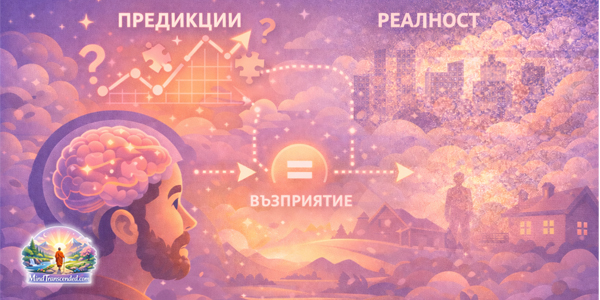
Modern neuroscience offers an even deeper explanation through the theory of predictive processing. According to this theory, the brain is not a passive receiver of information. It constantly generates predictions about the world and compares them with sensory data. Perception is the result of this interaction – between expectation and signal. This means that we do not see the world as it is, but as our brain expects it to be. When the data are unclear or noisy, the brain relies more on its models. It “fills in” the gaps. And sometimes, in this process, it creates meaning where there is none. This explains why under conditions of uncertainty – stress, anxiety, lack of control – people become more likely to see patterns and signs. Not because the world changes, but because the inner model becomes dominant.
The Need for Meaning

But why is this tendency so persistent? Why do we not “outgrow” it with more knowledge? The answer lies in the fact that meaning is not merely a cognitive function. It is a psychological necessity. Studies show that when people feel deprived of control, they are more likely to discover patterns in random data. In one experiment, participants placed in situations of helplessness interpreted random financial charts as meaningful trends much more often than a control group.
Meaning creates a sense of order.
Order creates a sense of control.
And control reduces anxiety.
Thus the brain does not merely search for meaning – it uses it as a tool for stabilization.
From Mythology to Conspiracies
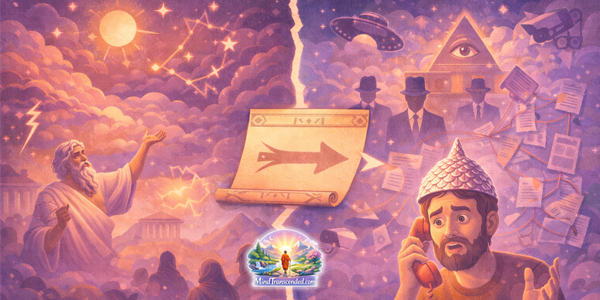
Historically, this tendency has shaped entire systems of belief. Ancient people saw intention in nature – gods in storms, will in the stars, messages in events. This was not irrationality, but a natural extension of cognitive mechanisms. In modernity, the same impulse appears in different forms – including conspiracy theories. They offer clear, ordered explanations in a world that seems complex and unpredictable.
Randomness is difficult to accept.
Meaning – even invented meaning – is bearable.
What Does This Mean for Us?
Here the most important question appears:
If our brain is inclined to create meaning, how can we distinguish truth from illusion? The answer is not to give up meaning. That would be not only impossible, but destructive. Meaning is what gives direction to life.
But we must distinguish between discovery and projection. Seeing a pattern does not mean that it exists objectively. Feeling a connection does not mean there is causality. The scientific approach offers a tool: doubt.
Not as denial, but as verification.
Not as denial, but as verification.
What Can We Do?
The first step is awareness. To know that our brain has a tendency toward apophenia.
The second – to ask questions:
– Is there evidence?
– Is there an alternative explanation?
– Is this a pattern – or just a coincidence?
The third – to consciously choose where we invest meaning. Because if everything can be interpreted, then the choice becomes ethical, not merely cognitive.
Why Is This Important?
The way we interpret the world shapes the reality in which we live. If we see meaning everywhere without verification, we risk living in illusions. If we refuse to see meaning at all, we risk losing direction. The balance is fragile.
Perhaps the deepest question is not whether the world has meaning, but how we relate to our own ability to create it. Your brain will not stop searching for patterns. That is its nature. But between noise and signal, between randomness and structure, there is a space – a place where understanding is born.
And perhaps precisely there, at this boundary, lies the truest meaning we can discover.
Read more:
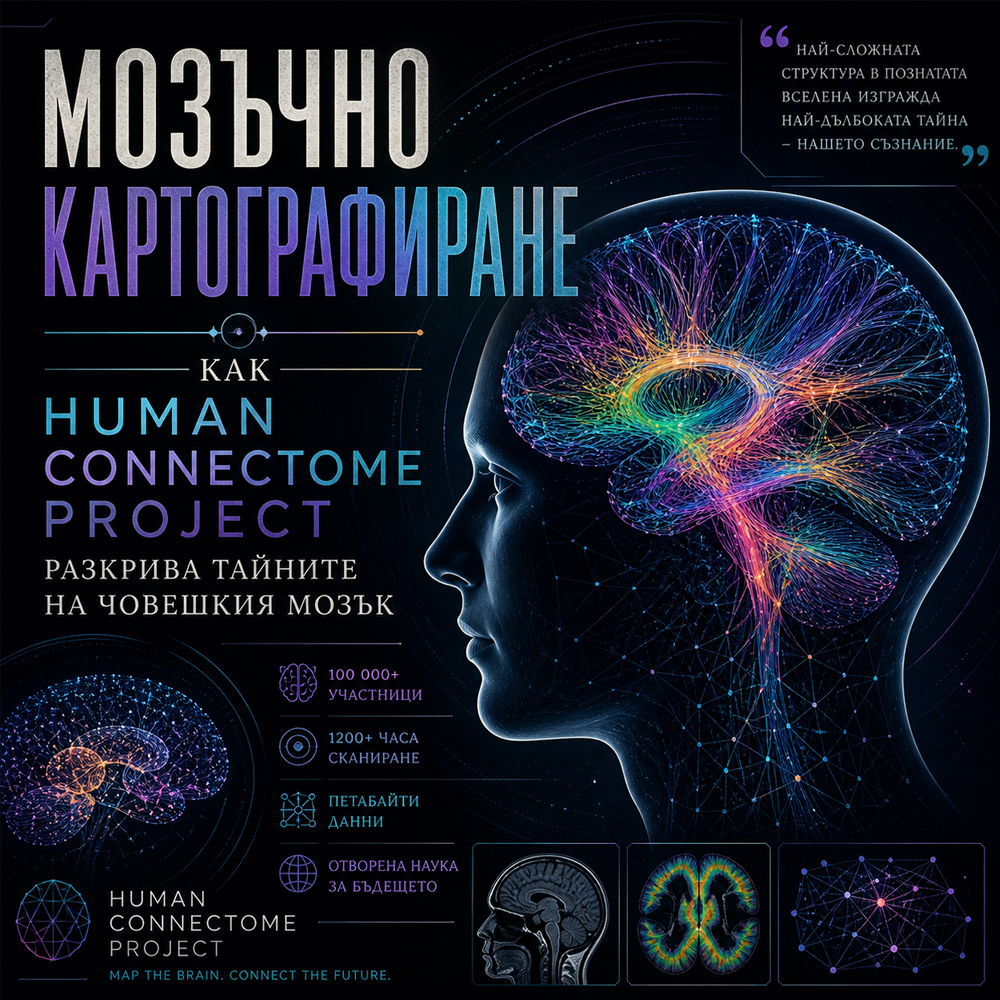
- Inside the Human Connectome Project: Revealing the Brain’s Hidden Connections
- DMT: The Spirit Molecule and the Mystery of Consciousness
- How Consciousness Emerged: Why Humans Developed It and What It Means
- How Social Media Changes the Brain: Dopamine, Attention, and the Collapse of the Inner World
Author: Vasil Stoyanov